Free wedding seating chart maker
Wedding table plan
A wedding table plan is the UK name for what Americans call a seating chart: the board at the entrance that tells each guest their table, and the planning behind it. This guide covers the questions couples ask most, from who sits on the top table to how many guests fit on a 5 ft round, when to finalise the plan and how to get it printed at A1 or A2.
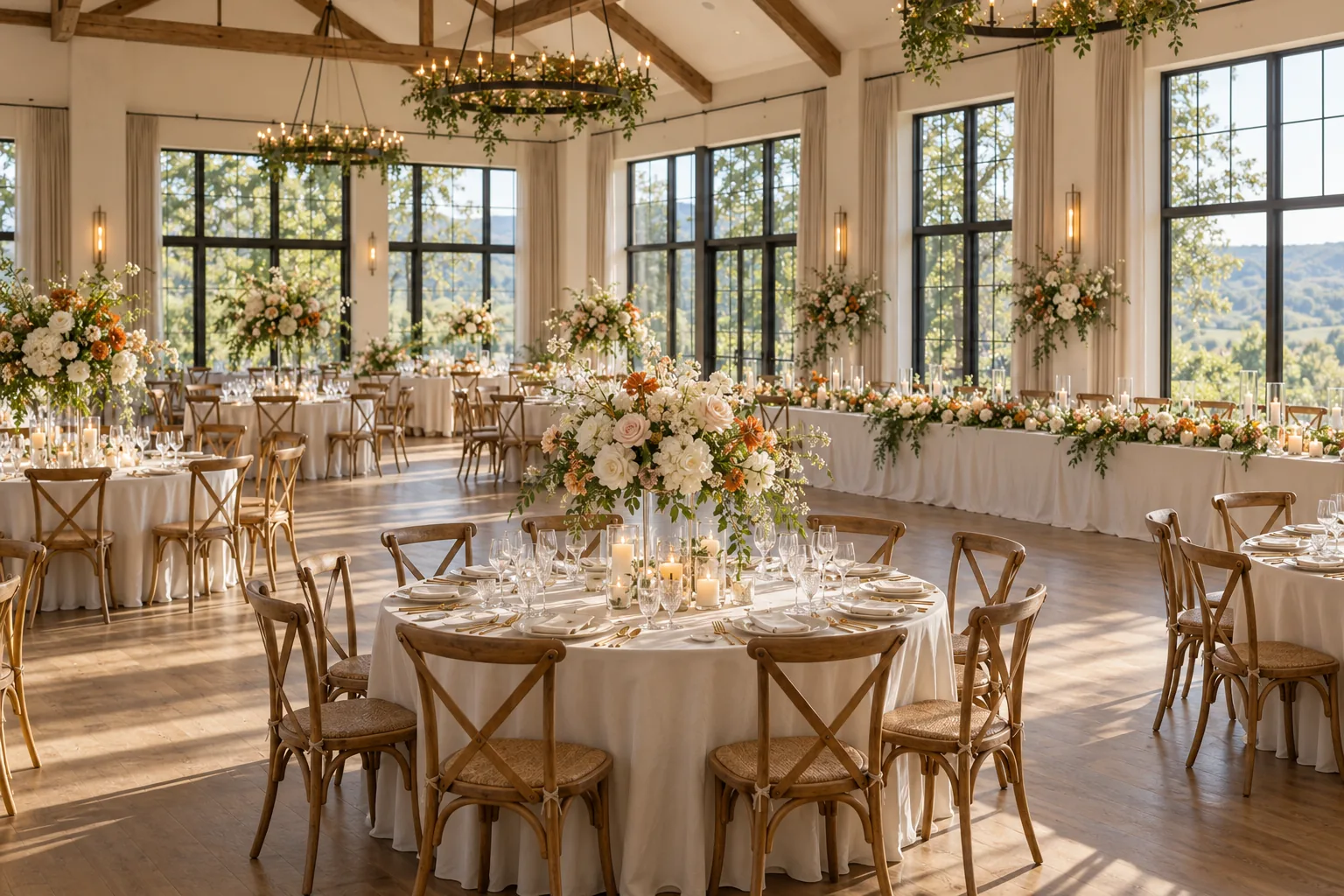
Table plan or seating chart: is there a difference?
No. 'Table plan' is British usage, 'seating chart' is American, and 'seating plan' is used on both sides. Stationers and venues in the UK will say table plan and expect a board for an easel at the entrance to the wedding breakfast; US vendors will say seating chart and may also expect escort cards. The object, the planning and the printing are the same.
The term matters only when you shop: UK print shops list 'table plan printing' in A1 and A2, US ones list 'seating chart' in 18 x 24 or 24 x 36 inches.
Top table etiquette
The traditional British top table is a long table facing the room, with the couple in the centre and the bride traditionally seated on the groom's left. As guests see it from left to right: chief bridesmaid, groom's father, bride's mother, groom, bride, bride's father, groom's mother, best man. Parents therefore sit next to the other family, not their own, and the wedding party bookends the row.
Few weddings follow this exactly, and no venue will mind. Common variations are a sweetheart table for the couple alone, with parents hosting their own tables; a top table of the couple and the wedding party only; or parents at the ends with their partners included. With divorced parents, seat each parent with their current partner at separate tables unless everyone involved tells you they are comfortable side by side. For two brides or two grooms there is no tradition to follow: seat the two families symmetrically and put whoever gives a speech near a microphone.
Round or long tables: how many guests per table?
Ask the venue for its table sizes before you plan anything; the figures below are the comfortable capacities caterers work to, with the squeezed number in brackets. Rounds are easier to balance and better for conversation across the table; long tables (trestles or banqueting tables) seat more people per square metre, suit barns and marquees, and limit each guest to the four or five people nearest them.
- 4 ft / 120 cm round: 6 guests (7 squeezed). Good for children or a small top table.
- 5 ft / 150 cm round: 8 guests (10 squeezed). The most common wedding round in the UK.
- 6 ft / 180 cm round: 10 guests (12 squeezed), though conversation across the table gets hard.
- Long tables: allow about 60 cm / 2 ft of table edge per guest per side. A 6 ft / 180 cm trestle seats 3 per side, 6 in total, or 8 with a guest at each end; an 8 ft / 240 cm table seats 4 per side, 8 or 10 with the ends.
How to lay out the room
Put the top table where it can see every other table and no guest has their back to the speeches. Seat the oldest guests and anyone with a hearing aid away from the speakers and the band, and families with small children near a door rather than beside the dance floor. Leave at least a metre, ideally 1.5 m, between the backs of chairs so staff can serve and guests can leave without asking a neighbour to stand.
Number or name the tables and draw them on the plan in the same positions as in the room, so a guest reading the board knows which way to walk. The free Seating Plan planner lets you draw round and long tables, the dance floor, the bar and the cake table to the room's proportions, with 'keep together' and 'keep apart' rules and an auto-seat that fills in around the guests you placed by hand.
When to finalise your wedding table plan
Set the RSVP deadline three to four weeks before the wedding and start the plan the day after it, with confirmed guests only. Most venues and caterers ask for final numbers and meal choices one to two weeks before; that is when the plan has to be fixed, because the room will be set to it. Leave the poster unprinted until final numbers are in, then allow the print shop's turnaround plus a day for a reprint.
Expect late changes anyway. Keep a seat or two spare rather than filling every chair, so a surprise plus-one has somewhere to go, and give the venue coordinator a printed table-by-table list with meals and allergies. A name left on the board for a guest who did not come is harmless; a guest who arrives and finds no seat is not.
Printing a wedding table plan at A1 or A2
A1 is 594 x 841 mm and suits plans for roughly 100 to 200 guests; A2 is 420 x 594 mm and is enough for most weddings under about 120. Both fit a standard display easel. Supply a PDF with real text rather than an image, so names stay sharp at any size, and ask for a matt finish: gloss reflects venue lighting and makes the board hard to read from an angle.
For a board that stands on its own, have the print mounted on 5 mm foam board (Foamex is the heavier, weatherproof option for marquees). Online poster printers are cheaper and deliver in a few working days; a local print shop can usually turn an A1 around in one or two days, which matters when the file is only final a week before. Print the place cards and catering list at the same time so everything comes from one version of the plan.
Free wedding seating chart maker
Paste your guest list, drag people onto tables, let the planner seat the rest. Everything stays in your browser. Print the chart when it's final.
Wedding seating chart questions
- What size is a wedding table plan?
- Usually A1 (594 x 841 mm) for 100 to 200 guests or A2 (420 x 594 mm) for smaller weddings. Both fit a standard easel.
- How many people fit on a round wedding table?
- 8 on a 5 ft (150 cm) round, 10 on a 6 ft (180 cm) round. Each can take two more if squeezed, at the cost of elbow room.
- Who sits on the top table at a wedding?
- Traditionally the couple, both sets of parents, the chief bridesmaid and the best man, with the bride on the groom's left. Many couples now use a sweetheart table or seat parents at their own tables.
- When should you do your wedding table plan?
- Start it after the RSVP deadline, about three to four weeks before, and finalise it when the venue asks for final numbers, usually one to two weeks before.